
Massachusetts DUI Records
Massachusetts DUI records and OUI records are filed and maintained through the state court system, primarily in District and Superior Courts across all 14 counties. You can search Massachusetts OUI records online through the free MassCourts portal, request criminal history through the DCJIS, or pull a driving record from the Registry of Motor Vehicles. This guide covers every way to find and access Massachusetts DUI records, what those records contain, and what laws govern them.
Massachusetts DUI Records Overview
What Are Massachusetts DUI and OUI Records
Massachusetts uses the term "OUI" rather than "DUI." OUI stands for Operating Under the Influence. Both terms refer to the same offense: driving a motor vehicle while impaired by alcohol, drugs, or both. In practice, people use DUI and OUI interchangeably when searching for records in the state. The courts, the RMV, and law enforcement all use "OUI" in their official documents.
Massachusetts DUI records and OUI records are created at multiple points in the legal process. An arrest generates a police report and booking record. A court filing creates a docket entry in the state's court system. A conviction, dismissal, or Continuance Without a Finding (CWOF) generates a case disposition. Each of these events produces a separate type of record, held by a different agency. Understanding which type of record you need helps you go to the right place.
OUI records include arrest data, court case filings, case outcomes, sentencing, probation records, and license suspension records. A case that ends in a CWOF, for instance, still appears in CORI as a criminal case. A dismissal also appears. So does a not-guilty finding. The full history of the case shows up, not just the conviction. RMV records separately track all license actions tied to OUI charges, whether or not the case went to trial.
Note: Massachusetts uses "OUI" in all official documents. When searching court systems or requesting records, use OUI as the case type to find Massachusetts DUI records accurately.
How to Search Massachusetts OUI Records Online
The fastest way to find Massachusetts DUI records is the free MassCourts portal. This tool gives public access to court case information from District Courts, Superior Courts, and other court types across all 14 counties. You can search at no cost, right from your browser.
The Massachusetts Trial Court Case Access portal lets you look up cases by name, case number, case type, or ticket number. For OUI records, the name search works well when you know the person's full name. The case type search requires a 30-day date range and helps when you know roughly when a charge was filed. Case number searches require exact formatting, including correct capitalization and leading zeros.
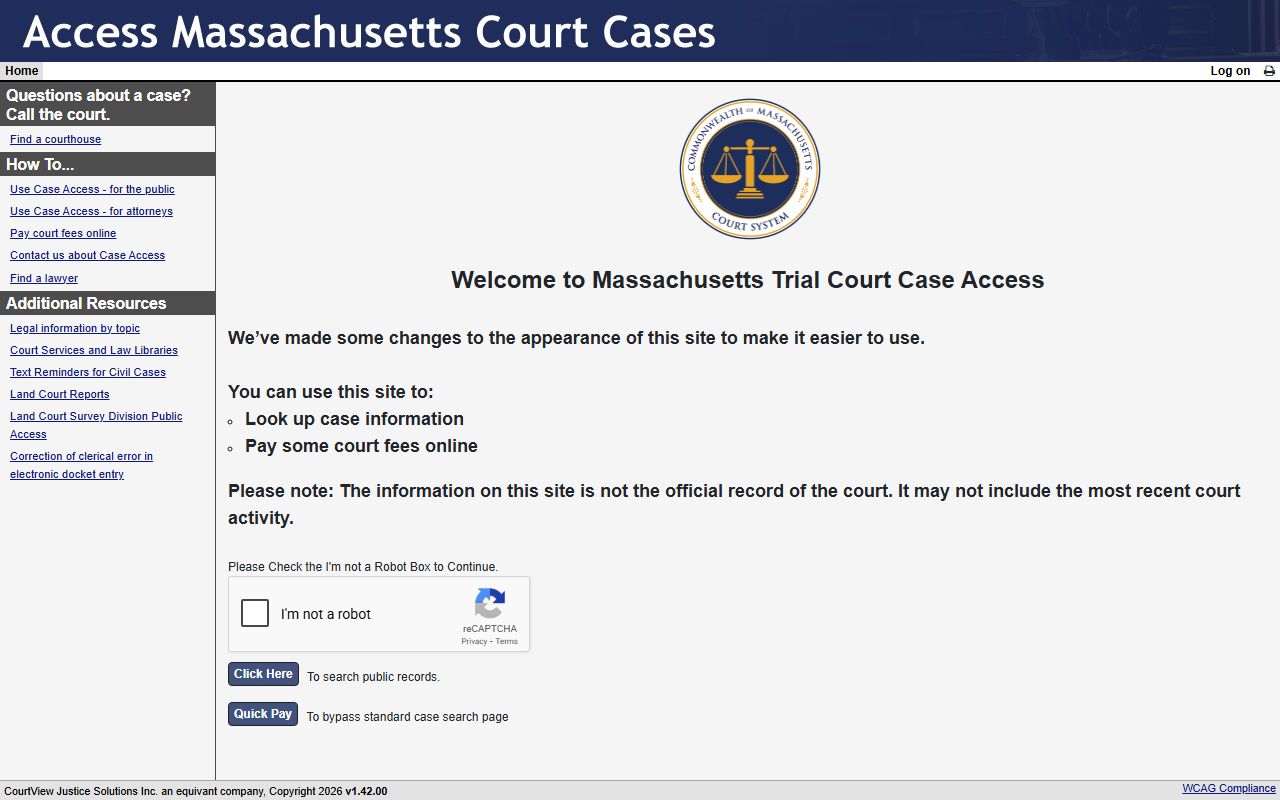
Once you find a case, the portal shows docket entries, hearing dates, party names, and current case status. It does not always include full document images, but it gives enough info to confirm a case exists and see its outcome. For full documents, you need to contact the court directly.
The official guide on how to search court dockets walks through each search method step by step. It explains what each field means and how to handle common search issues like capitalization errors or missing case numbers.
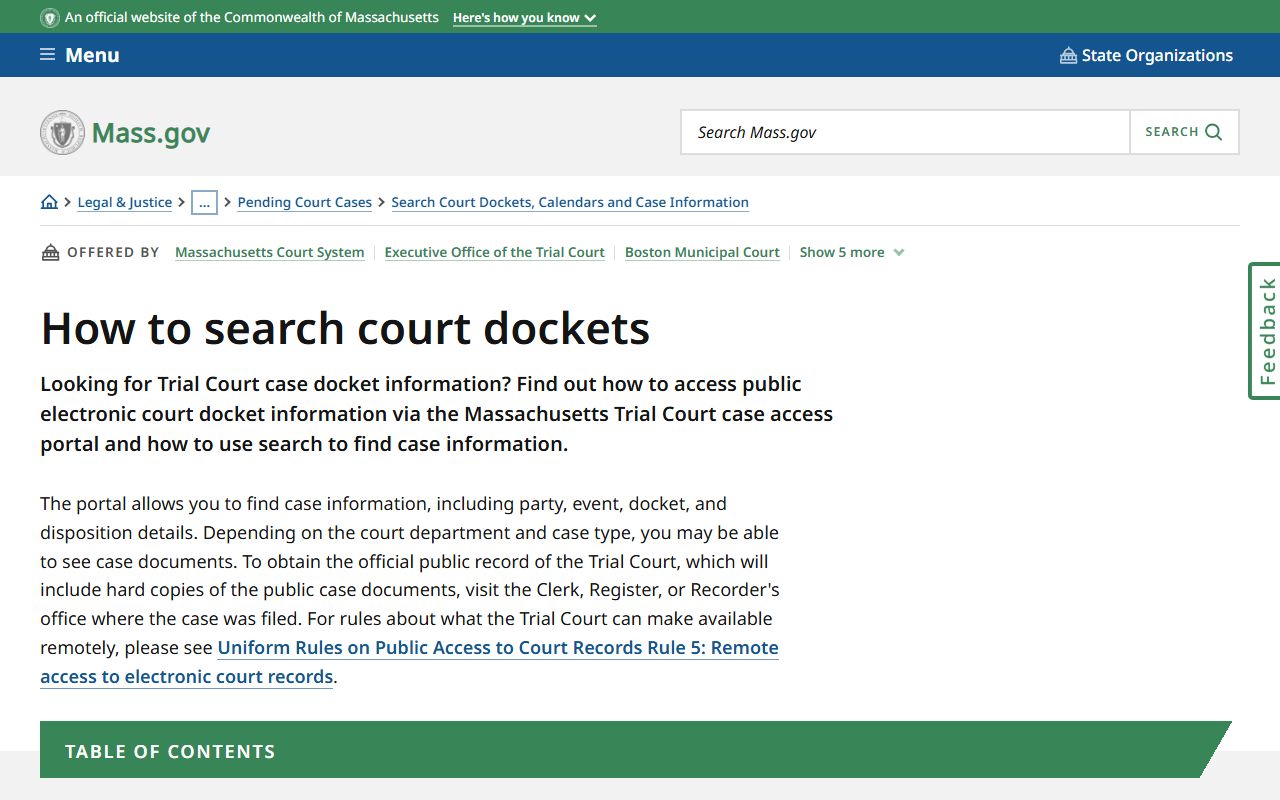
This guide is worth reading before you start. Search errors are common. The case number format matters a lot. Getting it wrong returns no results even if the case is there.
CORI: Criminal Offender Record Information
CORI is Massachusetts's centralized criminal record system. It is maintained by the Department of Criminal Justice Information Services, known as DCJIS. Every OUI conviction, every CWOF, and every dismissed OUI charge in a Massachusetts state court appears in CORI. This is the most complete single source for Massachusetts DUI and OUI criminal history.
You can request your own CORI through the DCJIS iCORI online service. The fee is $25. The request is processed online and results come back quickly in most cases. Individuals can access their own full CORI. Third-party access is restricted by law and depends on the requester's type and purpose.
CORI contains all criminal cases filed in Massachusetts state courts. That includes case dispositions such as guilty, not guilty, dismissed, and CWOF. It includes sentencing data. What it does not include: sealed records, juvenile cases, restraining orders, and federal court cases. A Massachusetts OUI record that has been sealed will not appear on a standard CORI check.
The MassCourts case access portal is a useful starting point before you request a full CORI, since it is free and shows public case data for OUI charges filed in state court.
Use the portal to confirm a case exists and find the case number before submitting a paid CORI request through DCJIS.
Note: CORI requests cost $25 per person checked and must go through the DCJIS iCORI system. Allow extra time if mailing a written request rather than using the online portal.
RMV Driving Records and Massachusetts OUI Records
The Registry of Motor Vehicles keeps a separate record of all driving-related offenses, including OUI. An RMV driving record shows criminal and civil driving offenses, license suspensions, accidents, and current license status. This is different from CORI. The RMV record focuses on your driving history. CORI covers your full criminal history in the courts.
The RMV driving record request portal offers two types of records. An unattested driving record costs $8 and is available online. It is for personal use only. A true and attested driving record costs $20, is official, and gets mailed directly to the record holder. Courts and legal proceedings typically require the attested version.
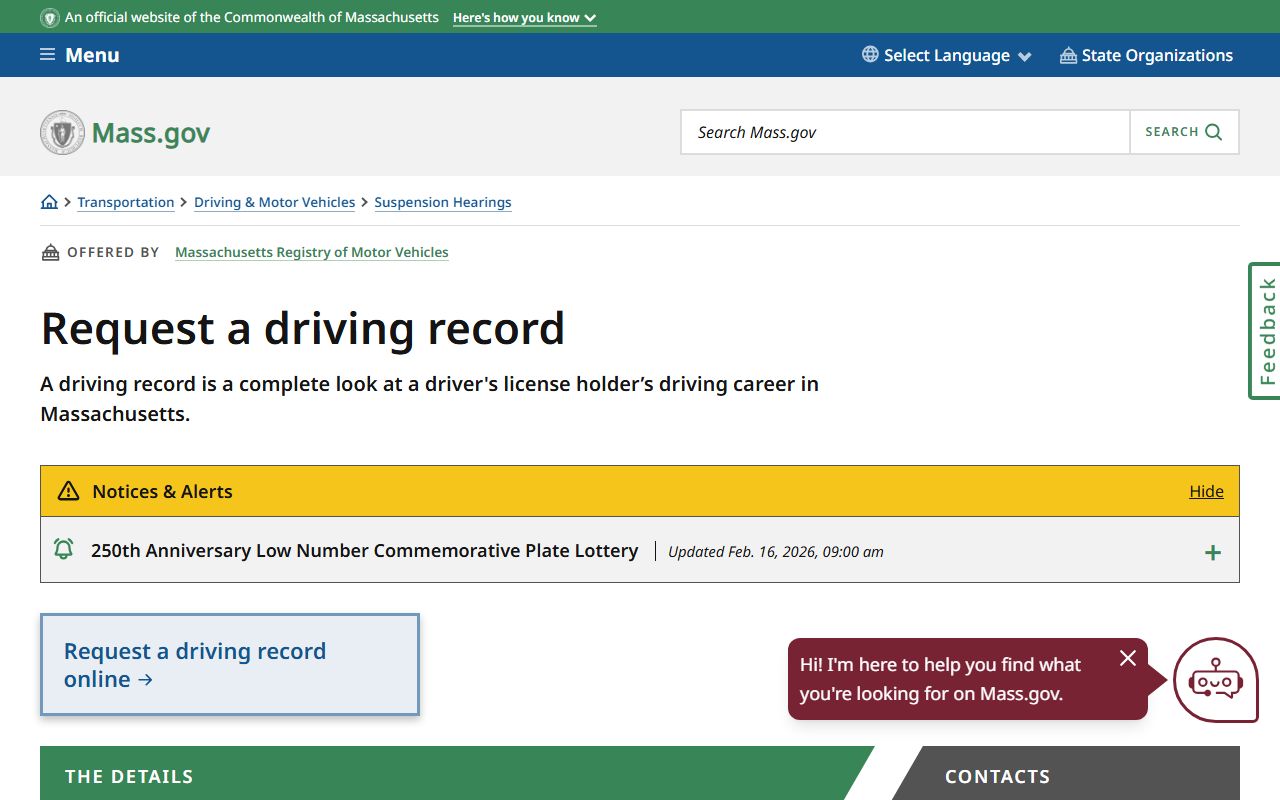
To request by mail, send your request to: Registry of Motor Vehicles, Court Records Department, P.O. Box 55896, Boston, MA 02205. Mail requests take about two weeks to process. Online requests are faster. You need your driver's license number, Social Security number, date of birth, and email address for the online process.
OUI convictions stay on your Massachusetts driving record for life. License suspensions from OUI charges also appear, even if the underlying criminal case was dismissed or resulted in a not-guilty verdict. The implied consent refusal suspension is recorded separately from any court outcome.
Massachusetts OUI Laws and DUI Penalties
The primary Massachusetts DUI statute is MGL c.90 § 24. This law defines the OUI offense and sets out all penalties. It covers alcohol, drugs, and any combination. The legal BAC limit for drivers 21 and over is 0.08%. For drivers under 21, the limit drops to 0.02% under the state's zero tolerance rule.
Penalties go up sharply with each offense. A first conviction under standard sentencing brings a fine of $500 to $5,000, up to 2.5 years in jail, and a one-year license suspension. However, many first offenders qualify for the 24D program under MGL c.90 § 24D. This allows a Continuance Without a Finding, probation, a shorter suspension of 45 to 90 days, and completion of an alcohol education program. The 24D route avoids a formal conviction but still appears in CORI.
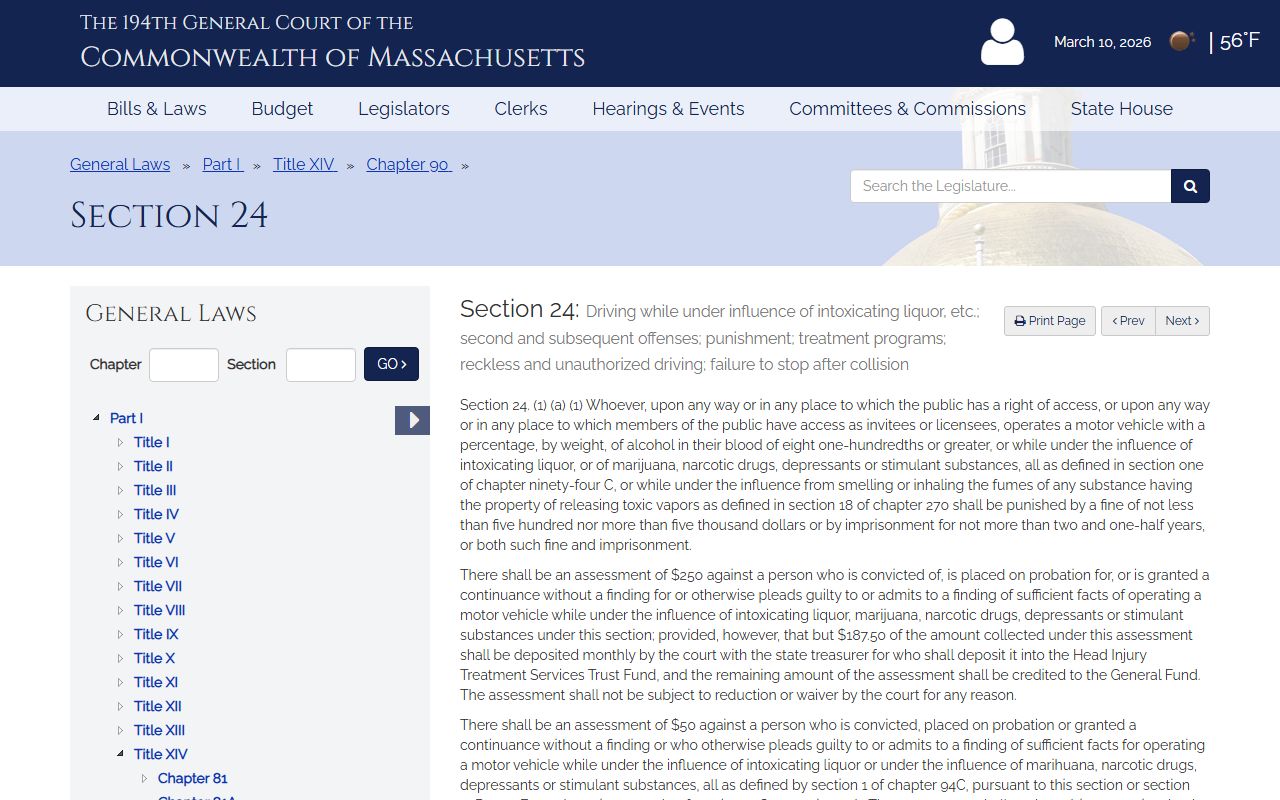
Second and subsequent offenses carry much heavier penalties. A second offense brings 30 days to 2.5 years in jail, fines of $600 to $10,000, and a two-year suspension. Third and higher offenses are felonies. A third offense means 180 days to 5 years, fines of $1,000 to $15,000, and an eight-year suspension. Fifth offense offenders face a potential lifetime license suspension and up to five years in state prison.
Melanie's Law, passed in 2005, strengthened Massachusetts OUI enforcement significantly. It added mandatory minimum sentences for repeat offenders, required ignition interlock devices after second and subsequent convictions, and toughened implied consent refusal penalties. The Massachusetts law about drunk driving page on mass.gov compiles all relevant statutes, cases, and regulations in one place.
Implied consent refusal carries automatic suspension periods separate from any court outcome. A first refusal means 180 days. Second refusal: three years. Third refusal: five years. Fourth and beyond: lifetime suspension. These penalties apply even if the OUI charge is later dismissed or results in a not-guilty verdict.
Note: A not-guilty verdict or dismissed case in court does not cancel an implied consent refusal suspension. The two penalties run independently through different systems.
The Massachusetts Court System and DUI Records
Most OUI cases in Massachusetts are filed in District Court. Each county has one or more District Court divisions. District Courts handle misdemeanor OUI cases, including first and second offenses. Third and higher offenses, which are felonies, may be prosecuted in Superior Court. The Massachusetts Court System homepage links to every court division in the state.
Court records in Massachusetts are public under M.G.L. c. 66, § 10, the state's public records law. Agencies must respond to records requests within 10 business days. For court records specifically, you contact the clerk's office at the court where the case was heard. Copies cost $0.05 per page for non-certified copies and $2.50 per page for certified copies. A certificate of orders costs $20.
You can request records in person, by mail, or in some courts by phone or email. In-person requests at the clerk's office are often handled the same day. Mail requests take longer. Include the full name of the defendant, the approximate case date, and the case number if you have it. The court clerk will search by name if you do not have the case number.
Sealing Massachusetts OUI Records
Massachusetts law allows OUI records to be sealed from CORI under certain conditions. Sealing removes the record from standard CORI checks, though law enforcement and certain government agencies can still see sealed records. The waiting periods depend on the type of case outcome.
First offenders who completed the 24D program are immediately eligible to seal their CORI upon finishing probation. There is no waiting period in that specific situation. For misdemeanor OUI convictions, the waiting period is five years from the end of the sentence. Felony OUI convictions require a ten-year wait. The clock starts from the date you finish any sentence, probation, or supervised release, not from the conviction date.
Sealing a CORI record does not affect the RMV driving record. The license suspension and driving history remain visible through the RMV system regardless of whether the court record is sealed. This is an important distinction. The two record systems operate independently.
To start the sealing process, file a Petition to Seal with the court where the case was heard. Forms are available at the clerk's office. There is no filing fee for a sealing petition. After sealing, the record is not destroyed. It still exists but is hidden from most standard searches. Information about reinstating your license after an OUI suspension is separate from record sealing and has its own requirements.
How to Request Massachusetts DUI Court Records
Getting copies of Massachusetts OUI court records takes a few steps. First, find the right court. OUI cases are filed in the District or Superior Court of the county where the offense occurred. Use the MassCourts portal to identify the court and find the case number before you make a formal request.
Once you know where the case is, contact the clerk's office directly. Most courts accept walk-in requests. Bring a photo ID and the case information. Staff will locate the file and make copies. Non-certified copies cost $0.05 per page. Certified copies run $2.50 per page. A certificate of orders, which is a summary document courts often require as proof, costs $20.
For mail requests, write to the clerk's office at the specific court. Include the full name of the defendant, the approximate filing date, and the case number if known. Enclose a check or money order made out to the court for the copy fees. Processing times vary. Some courts turn around mail requests in a week. Others take longer during busy periods. Call ahead to ask about current wait times before sending a request.
Note: Copy fees and procedures can vary slightly by court. Call the clerk's office before visiting or mailing to confirm current fees and what identification you need to bring.
Browse Massachusetts DUI Records by County
Each of the 14 Massachusetts counties has its own District Court and Superior Court that handles OUI cases. Pick a county below to find court contact info, local resources, and DUI record access details for that area.
Massachusetts DUI Records in Major Cities
Residents in major Massachusetts cities file OUI cases through the court serving their county. Select a city to find DUI record access resources for that area.